
When a project might be a good idea, it’s better for me to do it, then to worry about regretting it later. This project might be like that.
Vehicles will rust if they are parked on dirt as moisture comes up. The camper needs to be parked on the new asphalt, but the new asphalt needs to stay nice.
After Normandy High School had their parking lot paved, my motorcycle tipped over because the kick stand sunk in the unseasoned asphalt. It was a hot day, and little by little, the stand pad sunk in. This was my old Yamaha 650, so no harm done. I am leery of asphalt.
Nobody can say how much weight will dent asphalt because it depends on the temperature and a bunch of other stuff. Sites say 6000 lbs per axle, but that is a rule-of-thumb. Other sites say 140 lbs per square foot.
The camper weighs about 3500 lbs, with a tongue weight of 500 lbs. The real trick is that the tire pressure is 70 psi. That means 70 lbs on a square inch.
It’s all guess work.
The stabilizing jacks have a 500 lb capacity. Everybody has jack pads to accommodate soft ground at campgrounds and to save from extending the jacks as much. I made these from scrap wood, and travel with the camper.
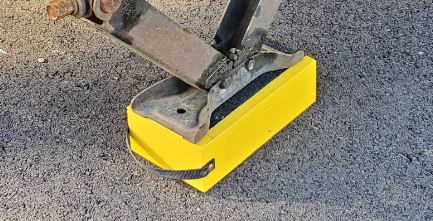
They are 5″ x 9″, so at 500 lbs, that’s 11 psi. That would be a maximum since the tires and tongue also carry some weight.
The tires are the biggest worry. The 70 psi internal pressure is directly transmitted to the asphalt. These are two pieces of 3/4″ plywood, with a tire chock build in. These are only for parking at home. The asphalt has a slight grade, so this chock is sufficient.
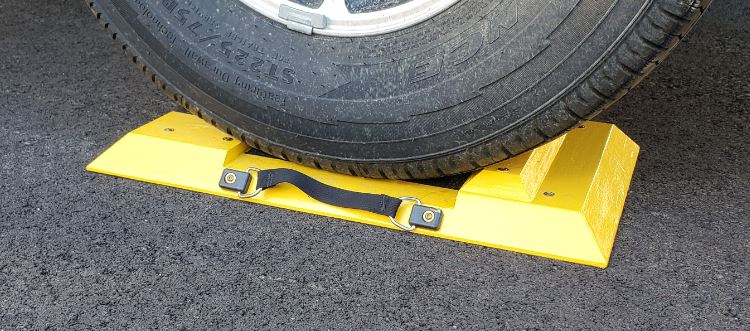
These are 13″ by 17″. If each tire is taking half of the camper weight, that’s 7.9 psi. The plywood will distort, so that the best case. Realistically, it’s about what the jack pads are applying.
The tongue stand is more about convenience, so the tongue jack doesn’t need to be fully deployed. This is only for parking at home, so it’s 12″ tall because there is a slight grade.

The base is 15″ by 16″ to get a truncated pyramid with sides at 67.5o. The angle is a little arbitrary, but is three-quarters of 90o. With a tongue weight of 500 lbs, yields a pressure of 2 psi. It’s mostly hollow with 3/4″ plywood sides and bottom with some internal braces.
It’s painted with yellow Rustoleum left over from a gas line painting project. That project was really a pointless retirement task, but whatever, it looks good in the basement. After that cured, two coats of polyurethane was applied.
Paint, under pressure, can stick to stuff, so the base of everything has 3M anti-slip safety tape. That also keeps the base from getting all crapped up and scratched. That was left over from projects I made for physics class.
The whole thing took time, which I have, and a half-sheet of 3/4″ plywood.
Wow, Rick, that was way too much math for me……..sounds hard to do whatever you’re doing, parking a camper!
Just gluing scrap wood together, and painting it.