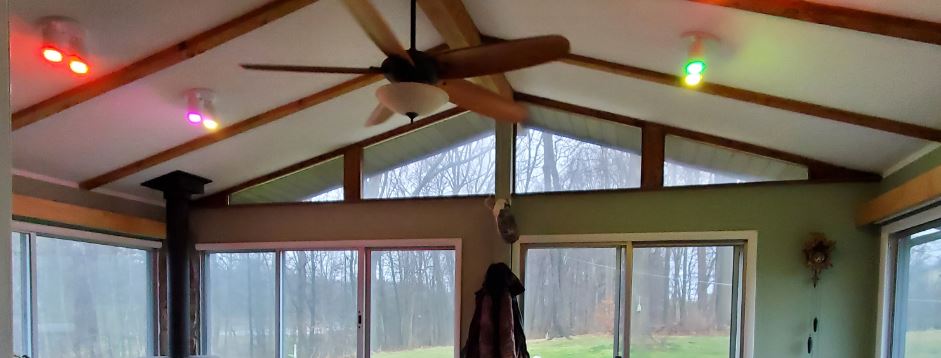
Winter can be bleak and dreary, especially when the snow is old and the sky is overcast. Nature is shades of gray. That can bring a fella down.
It doesn’t bring me down, I’ve got a beagle, but as part of my Continuous Improvement Plan, I added automatic color.
The solarium has eight ceiling-mounted spot light fixtures with Philips Hue bulbs. The Hue app is flexible. It provides a scene gallery with a wide variety of color palettes like Nutcracker, Dreamy Dusk, Blossom, Summer Splash and Tokyo. It can generate a color palette from a photo or a custom palette can be chosen.
The goal is to represent the visible spectrum, so I chose the primary colors of light (red, green, blue), the secondary colors of light (yellow, cyan, magenta). There are two lamps remaining, so orange and purple were added.
The app looks like this:

Looking at it like that, I should just pick a color every 45 degrees around the color wheel.
In dynamic mode, each lamp randomly cycles through the chosen colors. Select the brightness and transition speed, and the lighting keeps changing.
I’m still dialing it in. I don’t want the solarium to feel like a Japanese Pachinko parlor, so the transition speed between colors is about 15 seconds.
That’s all standard stuff. To make it automatic, The colored lights come on at dawn, but only if it’s cold and dreary. The software isn’t hard to figure out, and looks like this.

At dusk, the lights go from full power, down to 30%. At 11:30 pm, the spot lights are turned off, and the soffit lights are turned on low.
The Hue strip lights are only 10 ft long, rather than the 14 ft string they replace. I don’t like that so much, but fine for now.

There is an effect where the strip lights flicker like candles or a fire. It sounds cool, but is unnerving, so I’ll go with a solid blue or red. Those will be on from midnight to dawn.
Yeah, this is kind of a frivolous, make-work project, but it’s not pointless. I will learn what the robot lights can do and what I want them to do.
Leave a Reply