
7-ton asteroid lights up Northeast Ohio skies, fragments above Medina County
The boom was loud, deep and short. A crash or bang from the highway wouldn’t be such a deep bass sound. With the recent wind, trees have been falling over, but that would be cracking noise that would last longer.
News reports are sloppy.
Asteroids orbit the Sun, meteors are chunks of rock and ice that enter Earth’s atmosphere. It may have been an asteroid with an orbit that intersected with our own, but when it hit the atmosphere, it was a meteor. It’s a meteorite when it hits the ground.
The sound we heard was not the meteor exploding at altitude. It broke up as it heated up in the atmosphere. The sound was a sonic boom because it was traveling at a reported 45,000 mph.
We are very lucky it did break up. With an estimated weight of 14,000 lbs, if it had stayed together, it would have hit with an explosive energy of 500 lbs of TNT. That would have left a mark.
It apparently hit in Medina County. Based on the size of the fragments, people may find a small impact crater or meteorite.
There is only one documented case of someone being hit by a meteorite.
The Story Of The Only Confirmed Person To Be Hit By A Meteorite
This article is has security camera video of the first images of a meteor strike.
The Only Person To Ever Be Killed By A Falling Meteorite Was Extremely Unlucky
But your odds of being hit by a meteorite are always larger than zero. In a recent study, researchers attempted to calculate your odds of succumbing to various fatal events.
This article made some claims that seemed implausible.
That study found you are more likely to be hit by a meteorite than you are to get attacked by an elephant or a coyote, or be involved in a skydiving accident.
I think my chances of being attacked by a coyote are high enough that it’s prudent to be armed while taking Sparky out for a night walk.
Since journalists are sloppy, I searched for the study.
Placing the Near-Earth Object Impact Probability in Context
Placing the Near-Earth Object Impact Probability in Context
As I understand it, it’s not the odds of being hit by a meteor. It’s the odds of a meteor bigger than 140 meters, hitting the Earth in a person’s lifetime, versus the odds of an individual being attacked by a coyote or elephant.
Here’s a graphic from the study showing the odds.
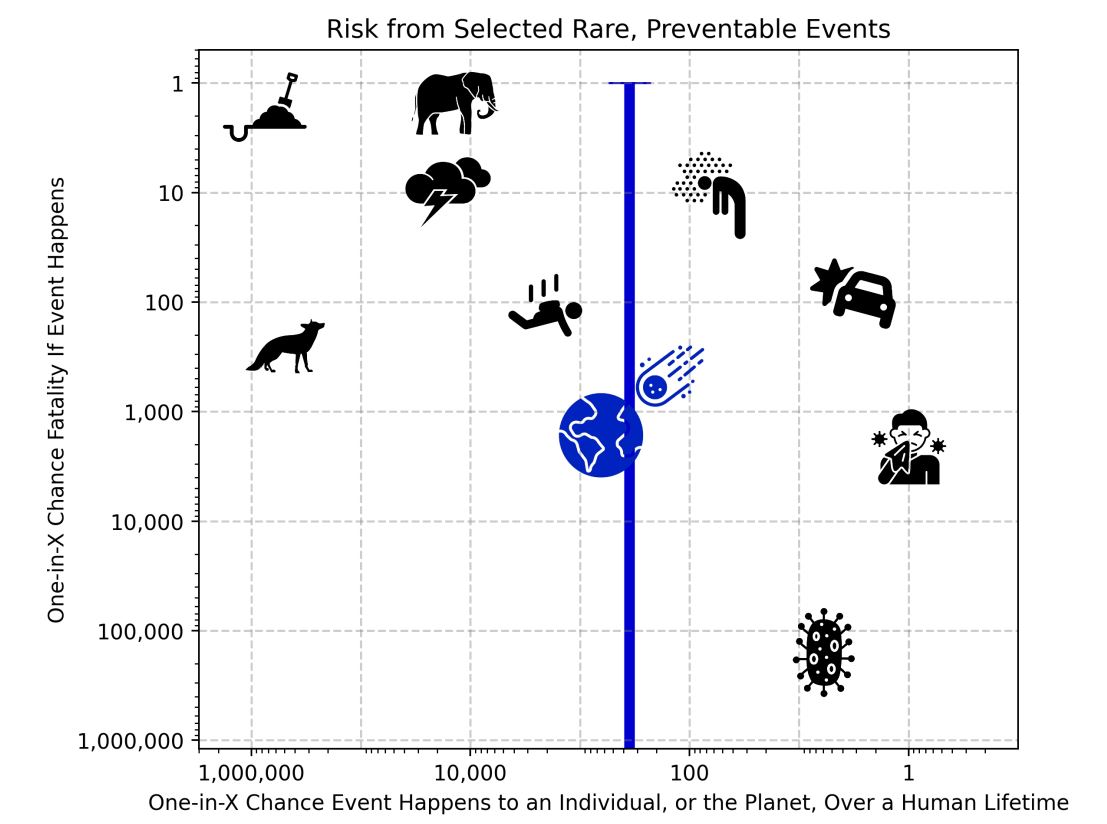
Here is the key that explains the symbols. Note that the x-axis is a logarithmic scale.
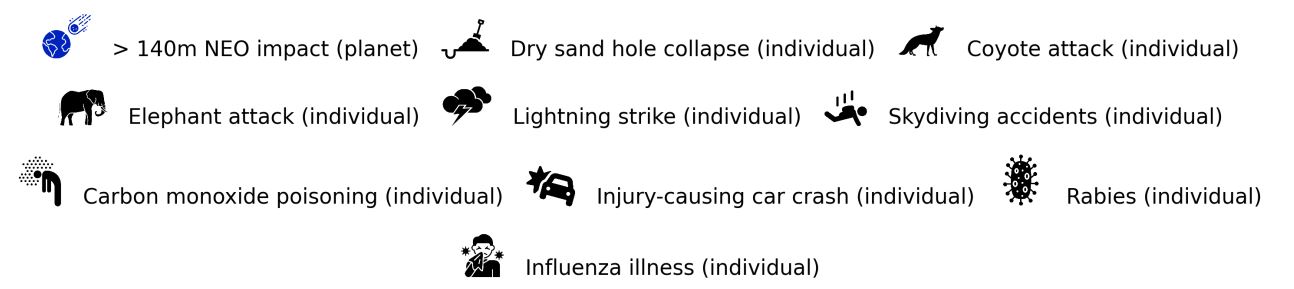
I’m done with this study, but skeptical that there is a 1 in 10 chance of a person getting rabies.
Leave a Reply