NPR: The ICE surge is fueling fear and anxiety among Twin Cities children
I like to listen to NPR when I wake up, and am still half-asleep. The mellow reporter lulls be back to sleep, or there is a story so delightfully melodramatic, that I am awake and ready to join the world.
“Every single patient I saw yesterday, we had some discussion over the increased stress, trauma, worry, anxiety, depression that is stemming from the presence of ICE in our communities,” says Dr. Razaan Byrne, a Minneapolis-based pediatrician at Children’s Minnesota, a pediatric health system.
Governor Walz and Mayor Frey are encouraging the locals to resist and impede federal law enforcement, and the locals are dragging their children along as props to these little rebellions, and I’m supposed to be moved. I can only laugh and wonder.
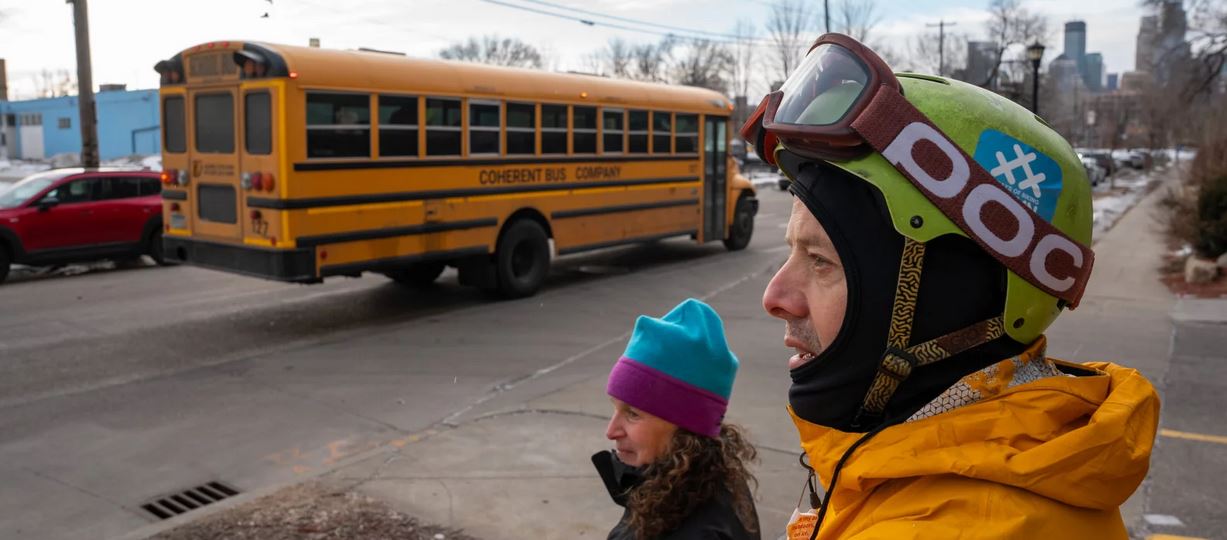
Can we talk about the autistic man looking at the school bus? The protective helmet suggested that he’s severely autistic or prone to self-harm, but he’s wearing goggles. He could be posing as a snowboarder. Minnesota is the land of 10,000 lakes, and very marginal alpine skiing. No shame in that, Northern Ohio has the same burden. If he had to wear a disguise, it would make more sense to carry a fishing rod.
To connect the audience with the message, there are interviews with relatable, normal people.
“We haven’t gone outside for anything in almost a month,” the mother, A, says in Spanish.
A lives here with her wife and two daughters, who are both U.S. citizens. Her daughters are struggling with the confinement.
“A lives here with her wife” Get it? Somehow, the illegal immigrants NPR found, happen to be a Hispanic lesbian couple with two anchor babies. In Minneapolis, 10% of the population is Hispanic, and in a Washington state study, 1% of Hispanics were lesbians.
Sure, just a random local they found to interview.
The toddler cries more, throws tantrums. Her 10-year-old can’t understand why they can’t leave the house.
“She keeps asking, ‘Why can’t we go outside, why can’t we play in the snow?’ And we tell her ‘No, no, you can’t be out there alone,'” A says.
Sure, if it weren’t for federal law enforcement, Moms would send a 10 year-old outside to play in the snow, alone, in Minnesota, in the middle of winter. In Minneapolis, it’s currently 5o F with 10 mph wind.
NPR also found a few citizens to interview.
“We live in an immigrant part of the city. That’s who’s at our bus stop. Those are our friends,” says Jennifer Arnold, the parent of a 7-year-old in South Minneapolis. “He immediately was really upset about it, crying in my lap, worried about what happens if one of his classmates’ parents is picked up when they are at school.”
A typical 7 year-old is moving passed picture books, and reading Captain Underpants or Magic Tree House. If the kid is worried about immigration enforcement, it’s because the parents have encouraged the child to be anxious and upset. Why would you do that?
Last week, a family trying to get around a volatile protest was tear gassed in their car. Their 6-month-old baby was hospitalized. Department of Homeland Security officials defended the actions of immigration officers.
Again, Minnesota in the middle of winter. The car windows were not open when the parent drove into a volatile confrontation. If the window had been broken by law enforcement officers, the article would have said so. The parent brought a 6 month-old baby to a riot and antagonized an immigration officer. Why would you do that?
None of this is happening in states that comply with federal law and cooperate with immigration officials who are performing their primary duties.
Governor Walz likes to think that he and his supporters are part of an epic civil rights struggle. They are, but not on the good side. In 1963, Governor Wallace was a Democrat, defying federal law by refusing to integrate the schools.
A person would need to have a heart of stone not to laugh at this pointless drama and NPR’s emotional coverage.
Leave a Reply